

Too Much of a Good Thing: the Story of Mulch Volcanoes

HRI Research • March 16, 2020

Welcome, Spring! Tender, new leaves are emerging, blossoms are blooming, plants are waking, and a fresh new crop of mulch volcanoes has formed. It’s almost as if they appear overnight – one day everything is peaceful and quiet in the landscape; the next day mulch volcanoes are everywhere. And they are not good.
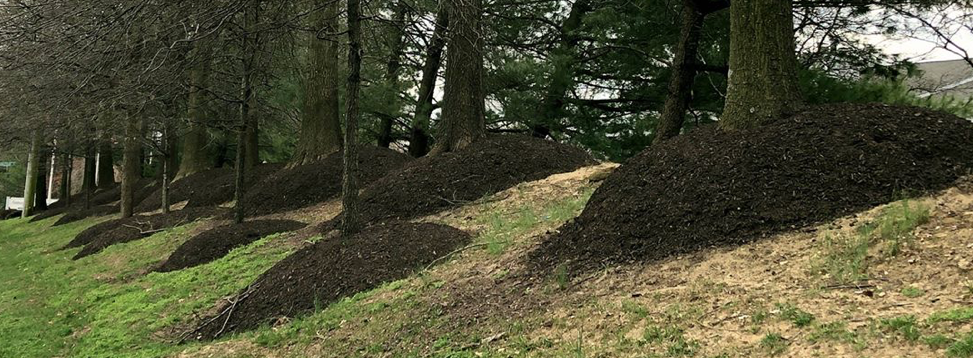
They look innocuous enough, just simple mounds of mulch around a tree. But underneath lurks a hot bed of trouble waiting to slowly erupt. They form under good intentions, often to help protect trees from lawn mowers and weed whackers. When the mulch is too thick, those well-meaning deeds lead to more stress for the tree.

Ideally, mulch should be no more than 2-3” thick, spread about 4-6’ diameter around the trunk, and not touch the trunk. This amount benefits trees greatly by acting like a blanket by moderating soil temperatures to keep summer temperatures down and winter temperatures up. Soil structure improves as well – aeration is better, erosion is lessened, and water can better penetrate the soil surface. Surface evaporation is also reduced, helping maintain soil moisture.
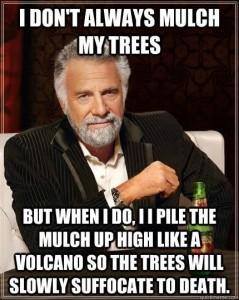
Source: Steve Bullmanl, arbtalk.co.uk

Mulch reaches volcano status when it reaches a depth of around 8-12”, sometimes more! This creates an environment where there is not enough oxygen for roots. The mulch compacts over time, which makes it even harder for roots to have access to oxygen. And it can smell bad. Fresh mulch should smell earthy; bad mulch turns sour from the buildup of hydrogen sulfide (rotten egg smell). Plus high mulch layers cause tree bark to rot and crack. This leaves the tree more susceptible to rodent damage, bark decay, and tree diseases (remember butt rot? Long live butt rot!).

Often the tree can confuse the mulch for soil and send out secondary roots all throughout the mulch. These shallow roots can encircle the tree or even grow upward instead of spreading outward, creating a weak support system for the tree. Shallow roots are also more susceptible to drought stress than those in soil.

All that translates to a slow death for the tree.

This can be corrected with a little hard work. First the mulch must be removed down to the soil line. Care must be given to remove secondary roots found during excavation, especially those encircling the trunk. Then add fresh mulch but aim for more of a flat doughnut shape and avoid the lava dome look.
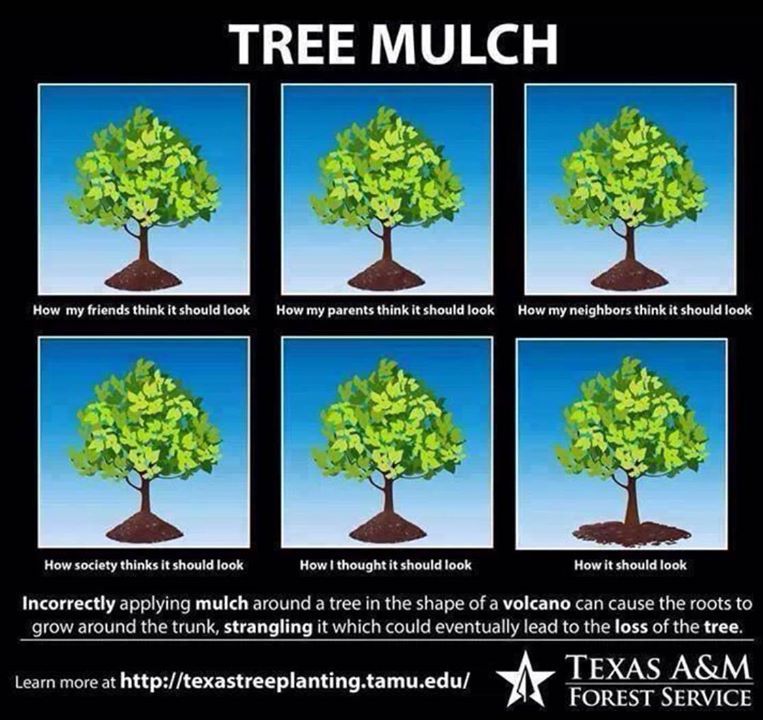
Here’s hoping one day we will live in a world free of mulch volcanoes!

Dr. Jill Calabro
HRI & AmericanHort Science & Research Director

Header photo courtesy J. Calabro.

admin's blog

Share This Post

Blurred green foliage filling the frame
By Jennifer Gray June 17, 2026
This session will introduce the HortCalculator, an online decision-support tool designed to help ornamental growers translate farm-level data into actionable financial insights. The tool generates clear analyses of profitability, breakeven points, and return on investment, giving growers confidence to evaluate sustainable production practices and new technologies. By linking financial literacy with production decisions, the HortCalculator helps growers balance profitability and sustainability, strengthening resilience in ornamental horticulture systems. The session will highlight practical applications for nursery, greenhouse, and specialty crop operations, while also exploring opportunities for research, education, and industry partnerships to scale the tool across crops and regions.
Blurry green foliage filling the frame
By Jennifer Gray May 28, 2026
Soilless Substrate Science (S3) is a national transdisciplinary collaboration developed to support growers as we advance to the next generation of substrates. Our team is leading North American efforts to develop new substrate materials and techniques, and working with growers to support implementation, as we support the global transition to substrates that go Beyond Peat. In this webinar, Dr. Jeb Fields will discuss the S3 team efforts surrounding identification of new substrate materials, processing and development, and grower support. We will explore wood fiber processing, sugarcane bagasse substrate development, stabilization of organic fibers, databasing substrate materials, and opportunities for growers to get involved. Overall, attendees will learn about US efforts to develop domestically-sourced substrates and advance substrate science as we move towards the next generation of substrate science. Our Speaker Dr. Jeb Fields is a production horticulturist who works with growers in Florida and throughout the country to support more effective and efficient production practices through his environmental nursery research program. Jeb’s primary interests include growing media & substrate science, irrigation & fertilizer management, whole plant-water relations and plant abiotic stress physiology. Jeb is an internationally recognized substrate scientist, the leader of the Beyond Peat project through the USDA Specialty Crops Research Initiative, and the national S3 (Soilless Substrate Science) team which pursues advancements of the global substrate industry and development sustainable substrate materials and practices, including substrate stratification. Jeb is the editor for Nursery & Landscape Insider, a biweekly e-newsletter from Ball Publishing, that reaches over 32,000 stakeholders worldwide. For his efforts, he has been recognized with numerous awards, honors, and leadership positions. Prior to joining UF, Jeb was a professor and research station director with the LSU AgCenter. Jeb studied at UF for his B.S., NC State University for his M.S., and Virginia Tech for his Ph.D. – with all degrees focusing on production horticulture.
A soft-focus background of varying shades of green, suggesting grass, foliage, or a forest landscape.
By Jennifer Gray April 9, 2026
This webinar dives into the problem of rose rosette virus. Shrub roses consist of multiple canes attached to a root system and produce beautiful spring growth in the form of new flowering stems and branches. Experts will provide an overview of how rose rosette virus first attacks flowering growth and can move throughout the stem. At the same time rosette symptoms appear in mature distinct stems of a plant and may be absent from others. The research delves into understanding how the vascular system connects the flowering stems and above ground canes. The research is to understand how virus movement between adjacent stems and only appears to cause disease in a few but not all canes of the same plant. This research is important to explore potential management approaches to safeguard rose.
Show More